
| Contact |
|
UB*CDE aphalen@buffalo.edu Phone: (716) 829-2320 Fax: (716) 829-2484 Click here for more information. |
COURSE
DETAILS Friday, May 11, 2012 Behling Simulation
Center UB
South Campus 8:30am-3pm 7 CDE
Credit
Hours ADA/CERP (incl. required reading) Breakfast/check in 8:30am Lunch included Who
Should
Attend Dental Teams Tuition $995
Dental Office Team (One dentist and two staff) $595 Dentist only Prerequisites BLS (ACLS is recommended) Recommended Textbook: Medical Emergencies in the Dental Office, Stanley Malamed, latest Edition, buy new or used online or download to electronic device. Please read chapters on asthma, heart attack, seizures and hypoglycemia. UB Faculty: Michael
N. Hatton , DDS, MS, is a Clinical Associate Professor in Oral
diagnostic Sciences and Clinical Assistant Professor in Oral and
Maxillofacial
Surgery at the School of Dental Medicine at Buffalo, New York. He also
serves
as the Director of Oral Medicine. Dr. Elizabeth R.
Hatton holds Masters
and
Medical degrees from Georgetown University, and is certified by the
American
Board of Family Medicine. She is a graduate of the UB Family Medicine
program,
and holds teaching appointments at both the UB School of Medicine and Dental Medicine. |
Crisis
Management During Medical Emergencies UNIQUE SIMULATION WORKSHOP DESIGNED FOR DENTAL OFFICE TEAMS, UTILIZING STATE OF THE ART FACILITY! VERY LIMITED ENROLLMENT! Hands-on participation at the UB Behling Simulation Center 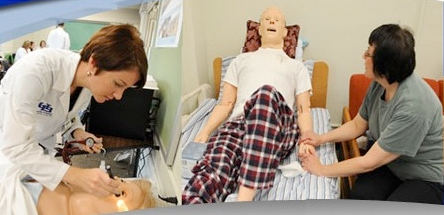
Friday, May 11, 2012 Medical emergencies in a dental office are of real concern in today's aging U.S. population. As patients age, they become prone to many acute physiologic problems that must be recognized, and managed, as first course by the treating dentist.
Dental teams need to be
prepared not only to administer CPR, but
must attend to other urgent care issues, such as allergic reactions,
seizures,
loss of consciousness, etc. Delays in EMS response time can occur both
in both
urban and rural areas practice settings. The dental team therefore must
assume
the role of "first responder" within their respective office
environment. For a dental office to be truly prepared for a medical emergency, 6 critical factors must be addressed. Together these items work together to form a response chain. Failure will occur at the weakest link. These 6 links of survival are: (1) dentist training, (2) staff training, (3) routine practice drills, (4) a written protocol with concise assignments for each person, and algorithms for common situations, (5) proper urgent care medications, and (6) proper resuscitative equipment. This course will address: syncope, angina, myocardial infarction, hypertension, hypotension, asthma, chronic obstructive pulmonary disease complications, hyperventilation, allergies, diabetic imbalances, and epilepsy/seizure disorders Hands-on
simulation helps teams and
individuals develop preparedness and insight
that is best learned and practiced
in realistic conditions. This translates into improved
real-world
communication, collaboration, teamwork, and crisis management. |

University at Buffalo CDE * 327 Squire Hall * Buffalo, NY 14214
Phone 716.829.2320 * Fax 716.829.2484 * Toll free 800.756.0328